Contracts — Module 1: Sources, Vocabulary & Mutual Assent Overview
Optional Legal Apprentice study aid — not legal advice; not a State Bar–approved school; does not replace your Mentor’s Rule 4.29 outline, monthly graded exams, or attestations; no guarantee of FYLSX/Bar credit or passage.


Lesson
Before you dig into offer, acceptance, and consideration, you need a map of which body of law applies and the vocabulary courts use when they ask whether a bargain formed. Year-1 survey exams (including FYLSX-style Contracts) reward clean threshold answers: Is this a goods deal under UCC Article 2, or a common-law deal for services, realty, or employment? That single choice steers almost every later rule.
Governing law: goods, services, and mixed deals
UCC Article 2 governs transactions in goods—movable things at the time of identification to the contract. Common law still governs services, real estate, insurance, and employment. Many real disputes are mixed: a contractor installs a furnace (goods) and performs labor (services). Courts apply the predominant-purpose test: look at language of the deal, nature of the supplier’s business, relative cost of goods versus services, and what the buyer primarily sought. If the predominant purpose is sale of goods, Article 2; if services, common law. Jurisdiction may vary on the exact factors, but the issue-spotting move is the same.
Mutual assent and the objective theory
A contract requires mutual assent—a meeting of the minds measured objectively. Courts ask what a reasonable person would understand from outward words and conduct, not what a party secretly meant. Offer + acceptance (with consideration or a recognized substitute) is the classic path. Keep labels operational: an offer is a manifestation of willingness to enter a bargain so made as to justify another in understanding that assent will conclude it; acceptance is a manifestation of assent to the terms; consideration is the bargained-for exchange that makes the promise enforceable as a contract.
Bilateral, unilateral, express, and implied
A bilateral contract is promise for promise (I will pay if you promise to paint). A unilateral contract is promise for performance (I will pay $500 if you find my dog—acceptance by completing the act). Modern courts prefer to construe ambiguous offers as inviting bilateral acceptance (a return promise) unless the offer clearly calls for performance only. An express contract is stated in words; an implied-in-fact contract is still a true contract, with assent inferred from conduct (sitting in a barber’s chair and receiving a haircut). Distinguish that from quasi-contract (restitution): there is no bargain, but the law may impose an obligation to prevent unjust enrichment.
Status labels and merchant status
Executed means all duties performed; executory means something remains. Void means no contract (e.g., illegal subject in some formulations); voidable means a contract exists until the protected party avoids it (e.g., infancy); unenforceable means a valid agreement that a court will not enforce (classic Statute of Frauds bar on an oral land deal), though restitution may still be available. Under the UCC, merchant status matters: a person who deals in goods of the kind or holds out as having knowledge or skill peculiar to the practices or goods involved. Merchant status triggers special rules you will meet later (firm offers, confirmation memos, implied warranty of merchantability).
Brief hypo: Dana hires FixCo to remodel a kitchen. The written quote lists cabinetry and appliances at $18,000 and labor at $4,000. Mid-project they quarrel over delivery of cabinets. Predominant purpose is likely sale of goods (cost and primary object lean toward cabinets/appliances), so Article 2 is the starting point—though a court could weigh service intensity differently. Always state both sides briefly, then pick.
Master this module’s vocabulary and you will not lose easy points on formation essays that open with “UCC or common law?”
Learning takeaways
- Start every fact pattern by classifying governing law: UCC Art. 2 for goods; common law for services/realty/employment; predominant purpose for mixed deals.
- Mutual assent is judged by the objective theory—reasonable outward manifestation, not secret intent.
- Bilateral (promise for promise) is the modern default construction; unilateral (promise for performance) when the offer clearly invites an act.
- Express and implied-in-fact contracts are true bargains; quasi-contract is restitution without a bargain.
- Know void / voidable / unenforceable consequences, and that UCC “merchant” status unlocks special rules.
Practice
Multiple choice
Question: ** A software consultant agrees to design a custom inventory system for a warehouse and to install the licensed software package on the client’s servers. The fee allocates 80% to consulting hours and 20% to the software license. A dispute arises over a missed deadline. Which body of rules is the best starting point?
Check yourself — Answer: Answer: B — Under the predominant-purpose test, the deal is primarily for consulting services (hours and relative cost). Article 2 does not auto-apply merely because some software is involved; jurisdictions may debate whether software is “goods,” but the survey answer turns on predominant purpose.
Short IRAC / essay prompt (practice only — not a Rule 4.29 exam)
Prompt: ** Pat owns a landscaping company. Riley asks Pat to “do whatever you usually do for a front-yard refresh” and says, “bill me like last year.” Pat arrives, installs sod and a fountain pump Pat supplies from inventory, and works three days. Riley refuses to pay, claiming “we never signed anything and I never agreed to a fountain.” Pat sues for the reasonable value of labor and materials. Discuss mutual assent under the objective theory, whether any contract is express or implied-in-fact, any quasi-contract claim, and whether UCC Article 2 or common law likely governs.
Model issue-spotting (not a full model answer):
- Issue: Did the parties form a contract by objective assent (express or implied-in-fact), and if not, is restitution available? Which law governs?
- Rule cues: Objective theory; implied-in-fact from conduct; quasi-contract/unjust enrichment; predominant-purpose for mixed goods/services.
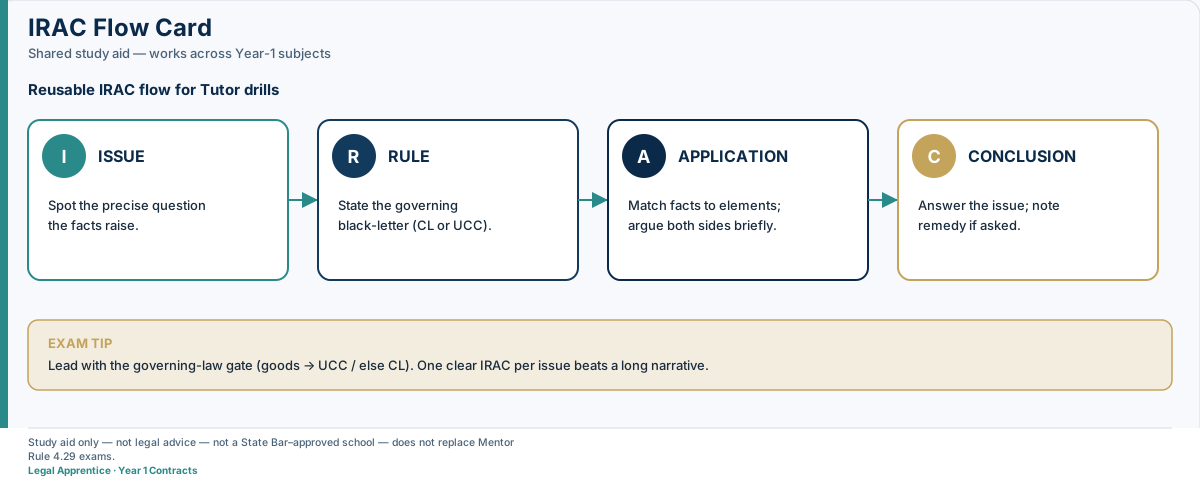
- Application cues: Prior course of dealing + “bill me like last year” supports assent to customary work; fountain may be within or beyond customary scope—argue both; materials vs. labor costs for UCC/CL.
- Conclusion cue: Likely implied-in-fact K for customary landscaping; fountain may need separate assent analysis; restitution backup; governing law depends on predominant purpose.
Disclaimer
Optional study aid only — not legal advice, not a State Bar–approved school, not a substitute for your supervising attorney’s Rule 4.29 outline, monthly graded exams, or attestations. Practice questions here do not satisfy Rule 4.29 monthly graded exams and do not count as State Bar study credit by themselves. No guarantee of FYLSX/Bar credit, approval, or passage. Verify current State Bar rules.